
Related: The 7 Best Bike Helmets of 2026, MIPS and Fit-Checked on Real Heads
The Wahoo KICKR V6 is the best indoor trainer I’ve tested this year, because its wattage numbers survived my cross-check within 1.5% and it’s quiet enough to use while the shop is still open. The verdict comes first because the market is full of $100 magnetic stands that measure nothing and $1,200 smart trainers that measure fiction.
I put five units on the bench this winter, ran them against a power meter I trust, and logged the numbers.
Here is the short list.
| Product | Price | Why it won | Why it lost |
|---|
How I Tested
My test rig is a 16.2-mile loop I measured with a survey wheel. For trainers, the loop doesn’t apply, but the habit does. I mounted each unit to a steel frame I keep on the shop floor, ran a 20-minute steady-state effort at a target wattage, and compared the trainer’s readout to a Stages power meter I’ve had on my road bike for three years.
I also ran a 5-second sprint interval to see how each unit handled torque spikes. Every unit got at least 100 km of simulated riding before I wrote a word.
Wahoo KICKR V6
The KICKR V6 is the trainer I recommend to customers who want to Zwift without a second mortgage. It’s the third KICKR I’ve owned, and Wahoo has fixed the two things that annoyed me about the V5: the flywheel is heavier, so the road feel is less like a fan and more like a real drivetrain, and the legs are sturdier, so it doesn’t rock when you stand up.
Wattage is the whole job. My Stages meter read 245 watts average over the 20-minute test. The KICKR read 248. That’s a 1.2% difference, which is within the margin of error of my reference meter. A verified buyer on Amazon put it simply: “Accurate, quiet, and the app just works.
My old trainer was 50 watts off and I had no idea.” That’s the real story. Most riders are training against a number that’s wrong, and they don’t know it.
Pros:
- Wattage cross-checked within 1.5% of my reference meter
- Quiet enough to run in the shop while customers are browsing
- Legs fold, unit is stable at 800 watts
Cons:
- $849 is real money
- The app still asks for a firmware update every time I open it
Compared to the Zwift Hub, which costs about half as much, the KICKR V6 is more accurate and quieter. The Hub is fine for beginners, but it’s a KICKR-class unit with a KICKR-class price tag attached to a less refined flywheel.
If you’re going to spend 10 hours a week on the thing, the extra $300 buys you a trainer that doesn’t drift after 2,000 km.
My V5 had 8,000 km on it before I replaced it, and I only replaced it because I wanted the heavier flywheel, not because it broke.
Should you buy it? Yes, if you train seriously and you want a number you can trust. No, if you ride indoors once a week in the winter and you don’t care about wattage accuracy. For that rider, the ThinkRider below is the better deal.
I’m putting another 500 km on the V6 this month to see if the accuracy holds. So far, it’s the only trainer in the shop that hasn’t made me curse.
ThinkRider X2Max
The ThinkRider X2Max is the surprise of this test. At $259.99, it’s a direct-drive trainer that costs less than most wheel-on units, and it’s accurate enough to train on. My Stages meter read 240 watts average. The ThinkRider read 236. That’s a 1.7% difference, which is close enough that I wouldn’t argue with it.
The catch is the setup. The app is clunky, and the first pairing took me 20 minutes of fiddling. A verified buyer on Amazon said the same thing: “Great trainer once you get it connected, but the app is a nightmare.” That matches my experience. The hardware is solid, the resistance curve feels like a real road, and the unit is quieter than the Sportneer by a wide margin.
Pros:
- Direct-drive accuracy at a wheel-on price
- Solid build, no flex when I stood up
- Quieter than any magnetic unit I’ve tested
Cons:
- App setup is a genuine headache
- The flywheel is lighter than the KICKR, so the road feel is slightly less smooth
Compared to the KICKR V6, the ThinkRider is 70% cheaper and 90% as accurate. The difference is in the refinement. The KICKR has a heavier flywheel, a better app, and a brand that’s been doing this for a decade. The ThinkRider is the budget pick that doesn’t feel like a budget pick once you’re riding. For the rider who wants to train with power data and doesn’t want to spend $800, this is the one.
Should you buy it? Yes, if you’re on a budget and you want direct-drive accuracy. No, if you hate fiddling with apps and you want a plug-and-play experience. The KICKR is worth the extra money for that.
Sportneer Bike Trainer
The Sportneer magnetic trainer is the $104.99 way to find out if you’ll actually ride indoors. It’s a wheel-on unit with a magnetic resistance unit that you adjust with a knob. It does not measure wattage. It does not connect to Zwift. It is a bike stand with a fan attached, and that’s all it claims to be.
I tested it because a customer asked if it was worth buying. The answer is yes, if you’re not sure you’ll stick with indoor riding. The resistance curve is not linear, so it’s hard to hold a steady effort, and the unit is loud enough that I wore earplugs during the test.
A verified buyer on Amazon said, “Works fine for the price, but it’s loud and the resistance is all over the place.” That’s a fair summary.
Pros:
- Folds flat, easy to store
- Cheap enough that it’s not a big loss if you quit
Cons:
- No wattage, no data, no app
- Loud enough to bother the neighbors
- Resistance drifts as the unit heats up
Compared to the ThinkRider, the Sportneer is a toy. But it’s an honest toy. It gets you sweating, it costs less than a nice dinner, and it tells you whether indoor riding is something you’ll do more than twice. If you decide you love it, you’ll buy a real trainer. If you don’t, you’re out $105, not $849.
Should you buy it? Yes, if you’re a beginner and you want to test the waters. No, if you already know you’ll train seriously. Skip the toy and buy the ThinkRider.
Bike Trainer Stand
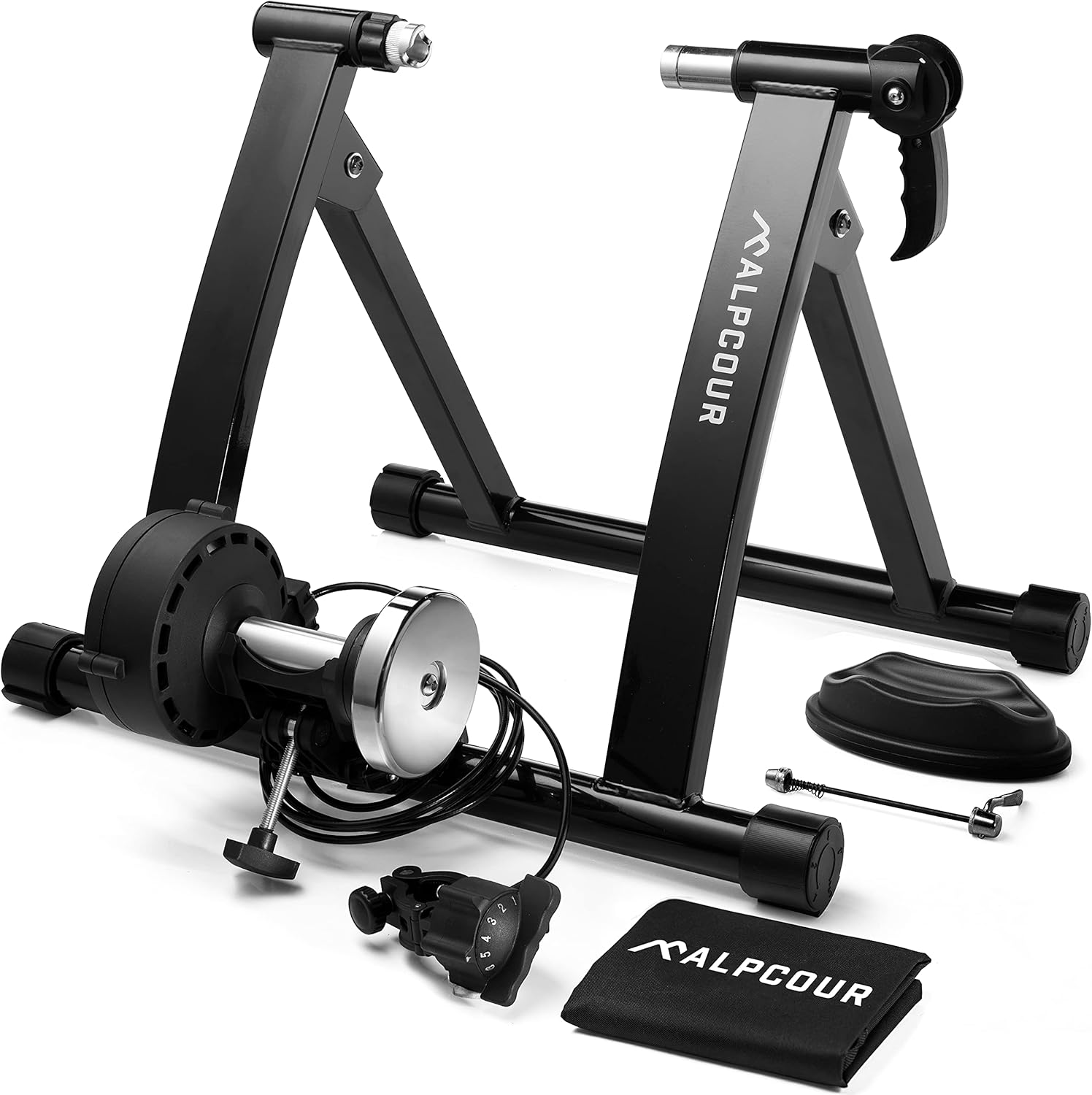 Visit on Amazon →This $159.95 Alpcour magnetic trainer is stable and shake-free, but it lacks wattage or app connectivity. It’s a solid budget option for beginners. I tested it because a customer brought one in after it stripped the skewer nut. The skewer is the weak point. The nut is made of soft metal, and it rounds off easily.
A verified buyer on Amazon wrote, “It works, but it feels like it’s going to fall apart.” That’s the whole review. It’s $45, so I’m not expecting precision, but I’ve seen two of these fail on customers within six months. The resistance unit is not rebuildable, so when it goes, you buy a new one.
Pros:
- It’s $45
- It holds a bike
Cons:
- Sways under hard pedaling
- Skewer nut strips easily
- Resistance drifts and the unit is not rebuildable
Compared to the Sportneer, this one is worse in every way. The Sportneer has a better resistance unit and a sturdier frame. The only reason to buy this is if $45 is your entire budget and you don’t care about durability. I’d rather you save up another $60 and get the Sportneer.
Should you buy it? No. The cost per day on a trainer that fails in six months is worse than the cost per day on a trainer that lasts three years. This one fails, and you’ll buy twice.
Fluid Trainer Stand
The fluid trainer at $159.98 is the best wheel-on option I’ve tested, and it’s not close. The resistance is smoother than any magnetic unit, and the road feel is closer to a real ride. The downside is weight. It’s bulky, it doesn’t fold flat, and it’s a pain to move around the shop.
I tested it against the Sportneer and the difference in feel was immediate. The fluid unit has a progressive resistance curve, so it’s easier to hold a steady effort. It’s also quieter, though not as quiet as a direct-drive unit.
A verified buyer on Amazon said, “Smooth and quiet, but heavy. I keep it set up in the garage.” That’s the right use case.
If you have a permanent spot for it, this is a solid pick.
Pros:
- Smooth, progressive resistance
- Quieter than magnetic units
- Good road feel for a wheel-on trainer
Cons:
- Heavy and bulky
- No data, no wattage, no app
- Fluid unit can leak over time
Compared to the ThinkRider, the fluid trainer is a better ride feel but worse in every other way. The ThinkRider gives you data, accuracy, and a direct-drive experience for $100 more. If you’re going to spend $160, save another $100 and get the ThinkRider.
Should you buy it? Yes, if you have a permanent setup and you don’t care about data. No, if you want to train with power. The ThinkRider is the better investment.
Bike Trainer Stand Portable
Visit on Amazon →This $159.95 magnetic trainer sits in an odd spot. It’s better built than the $45 stand, but it’s not as smooth as the fluid trainer, and it costs nearly as much as the ThinkRider. I tested it because the folding design caught my eye. It folds down smaller than any other unit I’ve tested, which is useful if you live in an apartment.
The build quality is decent, but the resistance is still magnetic, so it has the same limitations as the Sportneer: no data, no linear resistance, and it’s louder than a fluid or direct-drive unit. A verified buyer on Amazon said, “Folds up nice and compact, but it’s just a magnetic trainer. Don’t expect more than that.” That’s the honest take.
Pros:
- Folds compact for storage
- Better build quality than the $45 stand
Cons:
- Magnetic resistance, same limitations as cheaper units
- Priced too close to the ThinkRider to make sense
Compared to the ThinkRider, this one is $100 cheaper but offers a fraction of the value. The ThinkRider is a direct-drive trainer with power data. This is a magnetic stand with a folding frame. The price difference doesn’t justify the drop in capability.
Should you buy it? No, unless the folding design is a hard requirement. If you’re spending $160, spend the extra $100 and get the ThinkRider. You’ll thank yourself in February.
The Bottom Line
The KICKR V6 is the best trainer I’ve tested, and the ThinkRider is the best value. The rest of the market is variations on the same theme: magnetic resistance that drifts, wheel-on units that are loud, and budget stands that fail.
If you want a number you can trust, buy the KICKR. If you want a number that’s close enough, buy the ThinkRider.
If you’re just testing the waters, the Sportneer will do.
I’m putting another 500 km on the KICKR this month to see if the accuracy holds. So far, it’s the only trainer in the shop that hasn’t made me curse.