Most riders spend their money in the wrong order. A new wheelset gets approved without a second thought, while the four categories that decide whether a bike is safe, comfortable, and still shifting cleanly in three years get whatever is left in the account. That is how people end up with a fast bike, a numb backside, a dead headlight, and a chain that has quietly eaten a cassette. This piece is about cycling maintenance essentials: the unglamorous parts and consumables that keep a bike usable, and how to judge them without trusting a spec sheet that was written by someone in marketing.
The four products below cover four different jobs. One controls whether drivers see you. One controls whether your body tolerates the ride. One decides whether a mechanical problem ends your day or costs you twenty minutes on the shoulder. One is the reason your drivetrain lasts long enough to be worth upgrading. None of them are exciting. All of them are the kind of purchase you only regret once, and usually at the worst possible moment.
Related: How to Read a Bike Light Lumen Claim →
Quick answer
If you want the short version: buy visibility first, then the contact point, then the tool that gets you home, then the consumable that protects everything you have already paid for. A rechargeable front and rear light set makes you predictable to traffic after dark, a saddle that matches your position makes long rides tolerable, a compact multi-tool with a real chain tool covers the roadside repairs that actually happen, and chain lubricant is the cheapest insurance on the most expensive wear item on the bike. Match each one to how and where you ride, not to what a box claims.
Four useful options
| Model | Best fit | What stands out |
|---|---|---|
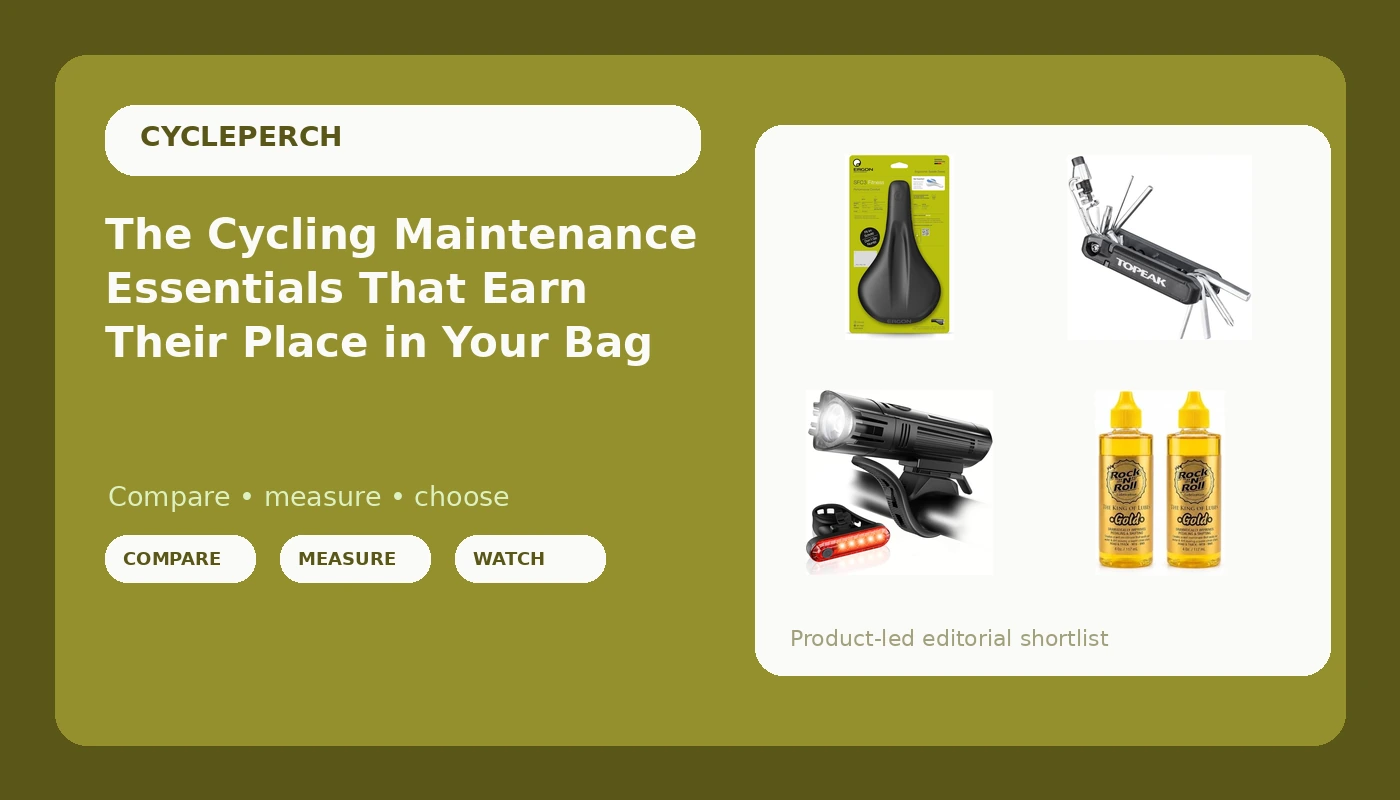
| Ascher Ultra Bright USB Rechargeable Bike Light Set, Powerful Bicycle Front Headlight and Back Taillight, 4 Light Modes, Easy to Install for Men Women Kids Road Mountain Cycling | Riders who need front and rear visibility from one purchase | Front headlight and taillight in a single USB rechargeable set with four light modes |
| Ergon SFC3 Fitness Bike Saddle, Comfort Bicycle Seat for Hybrid, Fitnes, Indoor Cycling Bikes, Orthopedic Foam, Pressure Relief Channel, Unisex Design, Two Sizes | Hybrid, fitness, and indoor riders chasing comfort over race weight | Orthopedic foam, a pressure relief channel, and a unisex shape offered in two sizes |
| Topeak Hexus X Multi-Tool, 21-Function Bike Repair with Chain Tool, Tire Levers and Presta Core, Compact Chrome Vanadium Design for Road and Mountain Bikes | Road and mountain riders who want one tool for most trailside fixes | 21 functions including a chain tool, tire levers, and a Presta core tool in chrome vanadium |
| Rock N Roll Gold Chain Lubricant, 4 Ounce (2-Pack) | Anyone who wants one bottle at the bench and one in the travel kit | A four-ounce bottle of chain lubricant sold as a two-pack |
Visibility: Ascher Ultra Bright USB Rechargeable Bike Light Set
The reason to start here is not brightness, it is completeness. Riders who buy a single front light and keep meaning to get a rear one are the riders I see at dusk with a silhouette and nothing else. A set removes that decision. The trade-off with any USB rechargeable light is that the battery is inside the housing, which means the light has a service life tied to a cell you cannot swap. That is a real cost, and it is worth knowing before you buy rather than after. The counterweight is convenience: a light you charge from a laptop cable is a light that is actually charged when you need it.
The contact point: Ergon SFC3 Fitness Bike Saddle
Saddles are the part of a bike where the spec sheet lies loudest, because comfort is geometry meeting a pelvis, and pelvises differ. A pressure relief channel is not a magic feature, it is a shape that suits some riders and not others. What makes this saddle a sensible pick for the hybrid and indoor crowd is that it is honest about its purpose: foam, channel, two sizes, unisex fit. The trade-off is that a wider, softer platform that feels great on a twenty-minute spin can feel like a couch on a two-hour effort, because padding compresses and takes your sit bones with it. If you ride more than an hour at a time, get your sit bone width measured before you order the larger of the two options. Width is a measurement, not a preference.
The tool in the bag: Topeak Hexus X Multi-Tool
The chain tool is the whole argument. Plenty of multi-tools include one so the box can list it, and it bends or strips the pin the first time you put real load on it, which is exactly the moment you cannot afford a failure. A chrome vanadium tool with a chain tool, levers, and a Presta core tool covers the three roadside problems that actually end rides: a broken chain, a stubborn tire, and a valve core that will not seal after you add sealant. The trade-off is weight and bulk in the jersey pocket. Twenty-one functions is more tool than a pure road rider needs, and if you never touch a chain on the road you are carrying grams you will not use. For everyone else, this is the item that turns a ride-ending failure into a fifteen-minute interruption.
Prices and availability may change. Product images, names, and retailer links must be matched by verified ASIN. Do not state a current price, rating, stock status, or measured result without current evidence.
The consumable people skip: Rock N Roll Gold Chain Lubricant
Lubricant is where the math is most lopsided. A chain, cassette, and chainring set costs more than everything else in this article combined, and all of it wears against a chain that you either maintain or replace. Buying lube is not fun, which is why people postpone it until the chain starts talking. Keeping two bottles removes the excuse, because the reason chains go dry is almost always that the lube is at home. The trade-off is application discipline. No lubricant compensates for applying it to a filthy chain, so wipe the chain, apply, let it sit, then wipe the excess. The bottle is the cheap part. The habit is the product.
Why these four categories swing the math
Think of the bike in two piles. The first pile is everything that makes it faster: wheels, tires, frames, components. The second pile is everything that keeps the first pile working: visibility, contact points, tools, and lubrication. Spending in the second pile is unglamorous but it compounds. A lubricated chain lasts measurably longer than a dry one, which delays the cassette and chainring replacement that costs ten times a bottle. A saddle that fits means you ride more, and riding more is the only upgrade with a guaranteed return.
Visibility works the same way. The moment daylight ends, your safety stops depending on your fitness or your line choice and starts depending on whether a driver registers you as a person on a bike. Front and rear lighting is the cheapest control you have over that outcome.
Tools and lubrication also share a property that gear rarely does: they make you independent. A rider with a chain tool and a spare quick link can fix the failure that ends other people's rides. That is not a performance gain, it is a resilience gain, and on a long ride, resilience is performance.
How to decide what your bike actually needs
- Audit your lighting first. Check what you own, when you last charged it, and whether you have both a front and a rear. If you are missing one end, close that gap before anything else.
- Measure your sit bones before buying a saddle. Foam pad at a shop, or the same test at home with cardboard and a ruler. Width comes from the measurement, not from the size that looks right on the shelf.
- Check your chain for wear with a chain checker. If it is worn past the wear limit, a new lubricant will not save it, and a new chain now is cheaper than a new drivetrain later.
- Open your saddle bag or tool roll and confirm the multi-tool actually covers a chain, a tire lever, and your valve type. Tools you have never used are tools you cannot trust.
- Set a maintenance interval you will keep, once a month or every few hundred kilometers, and treat lubrication as part of the wash rather than a separate job you get around to.
Practical guidance
- Charge lights after every ride that runs past dusk. A light that is 70 percent charged is a light that dies on the ride home.
- Wipe your chain before you lubricate it, then wipe it again after. Lubricant applied over grit grinds the drivetrain instead of protecting it.
- Replace a chain when a chain checker tells you to, not when shifting starts to feel strange. Strange shifting is late.
- Carry a quick link that matches your chain speed along with the multi-tool. A chain tool without a way to rejoin the chain only gets you halfway home.
- Torque saddle rail clamps to the seatpost manufacturer's spec with a torque wrench. Rail clamps are where "hand tight" turns into a crushed rail and a saddle that shifts under load.
Which option should you choose?
Choose the Ascher Ultra Bright USB Rechargeable Bike Light Set when you need front and rear visibility from one rechargeable purchase and you want the mounting to be simple. Choose the Ergon SFC3 Fitness Bike Saddle when comfort is the goal and your riding is hybrid, fitness, or indoor rather than race-position. Choose the Topeak Hexus X Multi-Tool when you want one compact tool that covers hex work, tire changes, valve cores, and chain repair on the road or the trail. Choose the Rock N Roll Gold Chain Lubricant, 4 Ounce (2-Pack) when you want a lubricant at the bench and a spare that actually travels with you.
None of these are verdicts about absolute performance, and it is worth being plain about that. The descriptions above come from the product listings, not from a bench test, and no measurement is being claimed here. Where a decision depends on your body or your bike, the measurement that matters is the one you take yourself, your sit bone width, your chain wear reading, your local dark hours, your valve type. Spec sheets are a starting point. Your own numbers are the answer.
The bottom line
The riders who spend the least over five years are rarely the ones who bought the most expensive parts. They are the ones who kept a chain lubricated, kept both lights charged, replaced a saddle that never fit, and carried a tool that could break a chain and put it back together. Buy in that order: visibility, fit, repair capability, then the consumable that protects everything downstream. The bike gets faster on its own once nothing on it is fighting you.