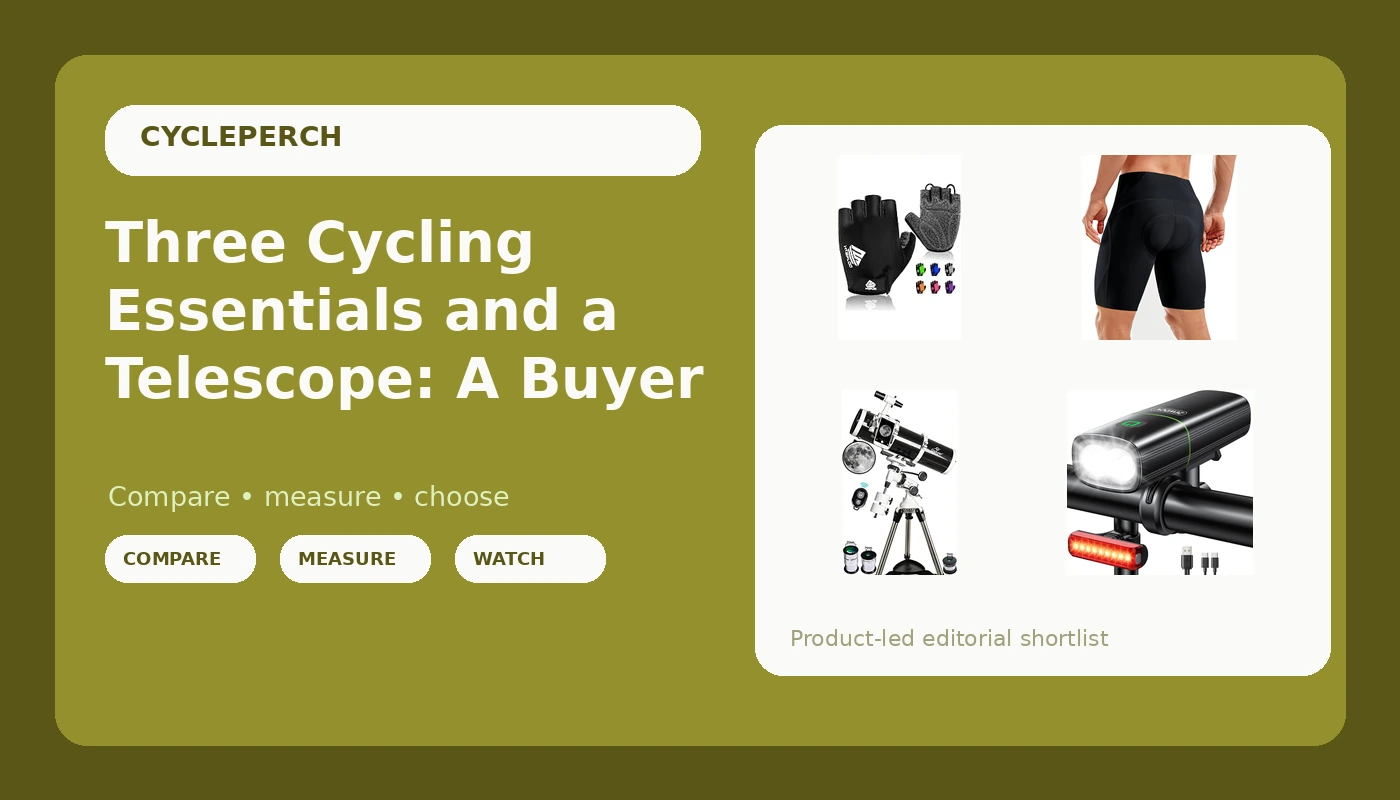
I've spent twelve years as a mechanic and the last five running a service desk, and the pattern never changes: the gear that comes back to my bench in pieces is almost never the expensive gear. It's the twenty-dollar thing bought in a hurry the night before a ride. So when I sat down to build this cycling gear comparison, I sorted the four products by a single question. What does this actually fix? Two of them fix comfort, one fixes the part of the ride where you're invisible to traffic, and one of them is a telescope, which I'll explain in a minute.
Related: Bike Lights Lumen Testing Explained
The short answer: the Zewdov light set is the purchase that matters most here, because lighting is the only category in this group where a cheap product can keep you out of a hospital. The Sportneer padded shorts and the half-finger gloves are honest comfort upgrades at a price that beats one hour of shop labor. The Gskyer telescope is not cycling gear, and I won't pretend otherwise.
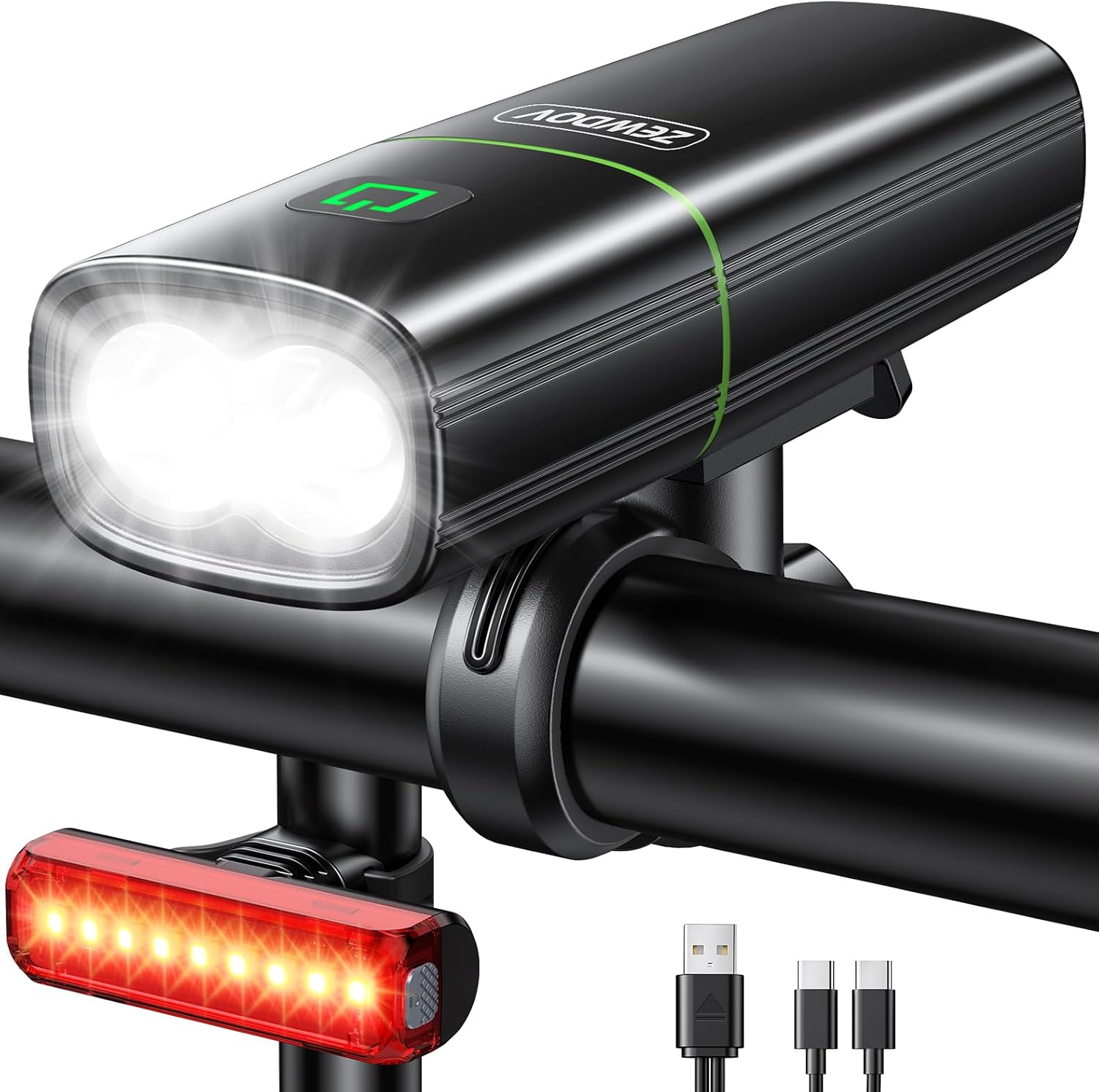
Zewdov 1200LM Bike Lights for Night Riding
Front and rear in one box, USB rechargeable, IP65 rated, and enough modes to cover a dark path and a lit street in the same ride. This is the category where spending changes your odds.
The lumen figure is a claim, not a measurement. Runtime at full output is the number that decides whether a light is useful, and it's the number nobody prints on the box.
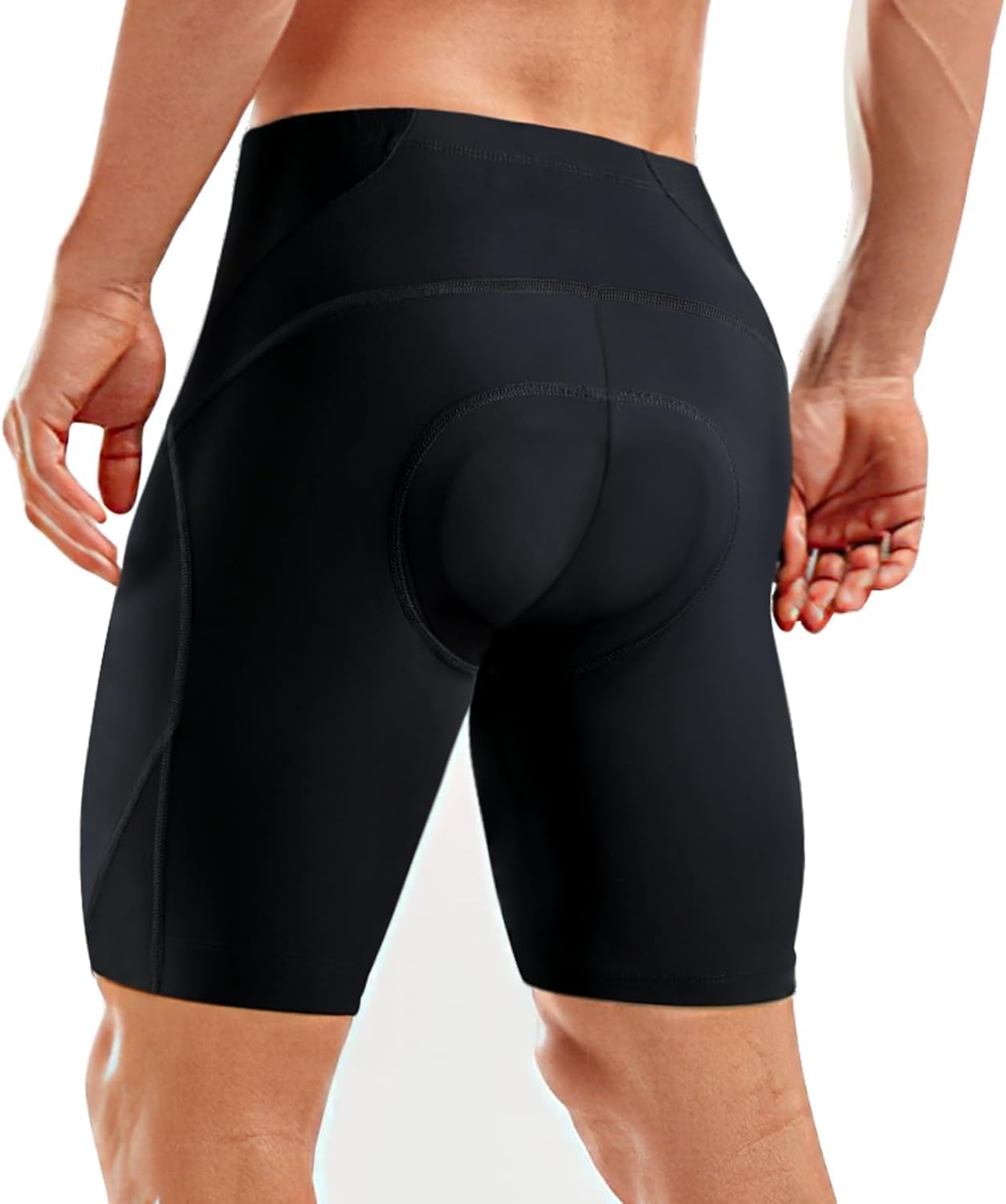
Sportneer Padded Bike Shorts for Men 4D Padding
4D padding and UPF 50+ in a short that costs less than one hour of shop labor. The cheapest legitimate fix for saddle discomfort that isn't buying a new saddle.
Budget chamois is where shorts fail. Padding that compresses flat by month three, and seams placed exactly where you don't want them.
Bike Gloves Cycling Gloves with Anti-Slip Shock-Absorbing Pad
Half-finger cut with a padded palm, which is the right call for summer riding and for anyone who still wants to work a phone or a multi-tool at a stop.
Palm padding is the first thing to pack out, and half-finger leaves the part of your hand that hits pavement fully exposed.
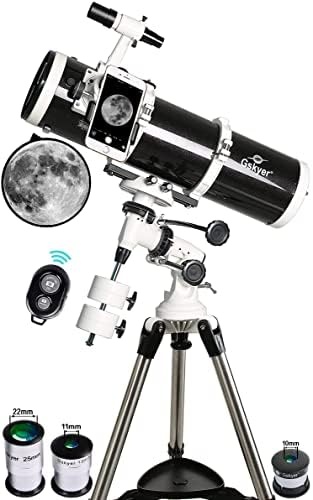
Gskyer 130EQ Professional Astronomical Reflector Telescope
A reflector on an equatorial mount is the honest entry into looking at the sky instead of your chainring, and it's a real instrument rather than a toy on a tripod.
It is not cycling gear. It will not make you faster, safer, or more comfortable on a bike, and no amount of creative writing changes that.
Prices and availability were captured from Amazon Creators API and may change.
How I judge gear like this
Three questions, in order, and I ask them about everything that lands on the bench.
What does the claim on the box actually mean? A lumen figure, a "4D" padding description, a UPF rating, an IP number. Each one is a shorthand for a test somebody ran, and each one can be true and still not tell you what you need to know. I keep an integrating sphere built out of a five-gallon bucket, flat white paint, a forty-dollar lux meter, and a hole saw, because the gap between the box and the bucket is usually the whole review.
What breaks first, and can I buy that part? A light whose battery is sealed has an expiration date, and the schedule is not yours. A short whose chamois flattens is a short you replace, not repair. Gear you can maintain is gear that stays.
How many shop-rate hours does installation cost you? A product that needs an hour of fiddling isn't a twenty-dollar product. It's twenty dollars plus an hour, and my labor rate is not a rounding error.
The light set: the one purchase that changes your ride
The Zewdov set claims 1,200 lumens across two LEDs, a 2,600 mAh battery, three plus five modes, and an IP65 rating. Those are the numbers on the listing. I don't have this particular unit in the bucket yet, so I'm not going to print a measured lumen figure and pretend it came from me. What I can tell you is what I'd check before it goes on a customer's bar.
Runtime at full output. A 2,600 mAh cell and a 1,200 lumen claim are in tension, because light output is a battery drain problem before it's anything else. Most lights at this price hold their peak number for a handful of minutes and then step down, which is fine as long as you know it. The number that matters on a commute is minutes at usable output, not the peak printed in the headline.
The mount. I have replaced more light brackets than I can count, and the failure is always the same: plastic that strips, a clamp that won't hold torque, a light that ends up on the pavement at kilometer twelve. Lezyne's bracket is the standard I hold everything else against because it doesn't strip. A cheap light with a good mount outlives a good light with a cheap one.
The port cover. IP65 is a rating against water projected from a nozzle. It says nothing about the little rubber flap over the USB port that you open with wet gloves in the rain. Drizzle kills more lights than downpours, because in a downpour people go home.
The rear light deserves more credit than it gets in this set. Being seen from behind matters more on most roads than lighting the road ahead, and having both in one box for this money is the reason this is my top pick of the four.
Padded shorts: where a budget chamois lives or dies
The Sportneer shorts carry 4D padding and a UPF 50+ rating. What the description can't tell you is the thing that decides whether you'll still be wearing them in August: how the pad behaves after twenty washes.
Here's the pattern from the shop. Budget shorts don't fail in week one. They feel fine for the first month, which is exactly long enough to trust them. Then the foam compresses, the pad goes flat under your sit bones, and suddenly you're getting the same saddle discomfort you bought the shorts to fix. The density of the foam is the spec nobody publishes, and it's the one that matters.
Seam placement is the second failure. A seam that crosses the wrong part of the pad turns a fifty-kilometer ride into a slow argument with your saddle. When you try a pair, sit on the bike in the driveway and pedal for two minutes before you cut the tags. If a seam is going to bother you, it will announce itself in those two minutes.
The third thing is fit, and it's the one riders skip. Padded shorts that bunch are worse than no padding at all, because bunched fabric creates pressure points where the pad folds. Measure your waist, order the size that matches, and ignore the instinct to size down.
At this price, my honest advice is to buy two pairs and rotate them rather than one pair of premium shorts. Two clean pairs mean you're never deciding between laundry and a ride, and the second pair is the one that saves your season.
Half-finger gloves: the cheapest comfort upgrade on this list
The gloves in this comparison are half-finger, lightweight, with an anti-slip shock-absorbing palm pad. That combination is a specific tool for a specific job, and it's worth being clear about which job.
Palm padding exists to spread pressure away from the ulnar nerve, the one that runs along the outside of your hand and produces the numb fingers that riders blame on their bars. Padding works when it sits in the right place and fails when it's a single gel blob in the center of the palm. A pad that covers the heel of the hand and the base of the thumb is doing its job. A pad that sits under the middle of your palm is decoration.
Fit matters more on gloves than on almost anything else you'll buy. Too loose and the fabric bunches into your palm, which creates exactly the pressure point the padding was supposed to remove. Too tight and you restrict circulation, which produces the same numb fingers by a different route. The glove should be snug with no wrinkles across the palm and no pressure across the knuckles.
The trade-off with half-finger is obvious and I'll state it plainly: your fingertips are bare, and fingertips are what hit the pavement first in most falls. If you ride in traffic or you ride in the cold, full-finger is the right answer and I'd tell you so in person. For summer rides, gym work, and anyone who wants to answer a text at a red light without peeling a glove off, the half-finger cut is the practical choice at this price.
The telescope, and why it's in here
The Gskyer 130EQ is a reflector on an equatorial mount. It is not cycling gear. I'm being direct about that because a review that pretends otherwise is a product page with extra steps.
So why include it? Because a lot of riders I know are already awake at 5 a.m. for reasons that have nothing to do with training plans, and the sky is right there. An equatorial mount is the honest way to look at anything for more than a few seconds, because it tracks the rotation of the earth on one axis instead of fighting it on two. The catch is that an equatorial mount rewards the person who learns to polar align it, and punishes the person who doesn't. If you're not going to spend an evening learning the setup, a simpler alt-az mount will frustrate you less, even if it's a less capable instrument.
The thing I'd check before buying any telescope is the mount, not the tube. A great tube on a shaky mount shows you a blurry moon and nothing else. Stability is the whole product.
The trade-offs, laid out honestly
- Lights versus everything else: the light set is the only item here that changes your safety. Everything else changes your comfort. If the budget is tight, that's the order.
- Short-term savings versus long-term cost: the shorts and gloves are cheap enough to be worth trying, but they're wear items. Budget on replacing them, not on keeping them forever.
- Peak claims versus sustained performance: every product in this group has a headline number. Peak lumens, UPF rating, padding description. The sustained number, minutes at output, months of padding life, seasons of glove wear, is the one that decides whether you got value.
- The telescope is a different hobby: buying it doesn't make it cycling gear, and it doesn't need to. Just don't let it eat the budget for a rear light.
How I'd spend the money
Lights first, without hesitation. A rider with a good light set and cheap shorts is safer than a rider with premium shorts and a dead taillight.
Shorts second, and buy two pairs if you can. The math is simple: two pairs of budget shorts cost about what one premium pair costs, and you'll ride more because there's always a clean one on the shelf.
Gloves third, and only if you're riding in warm weather. If you're riding in the cold or in traffic, skip straight to full-finger and thank me later.
The telescope last, and only if you actually want to look at the sky. It's a fine way to spend a clear winter morning. It is not a cycling purchase, and I'd rather tell you that than sell you one.
What I'm testing next
Winter is measurement season at the bench. The integrating sphere is getting a proper baffle, and the 2026 light lineup goes through the bucket one unit at a time, because a lumen claim in January is worth less than a runtime figure in February. Cold weather is where battery math goes to die, and a light that claims six hours at room temperature is a light I want to test at twenty degrees before I put it on anyone's bar.
The other thing on the bench is a saddle-fitting run for the spring season, foam pad and sit-bone widths, because half the riders who buy padded shorts are solving the wrong problem. Padding buys you an hour. Width buys you the season.